eLearn
  • Home
  • Calendar
  • Schools
    APPLIED BUSINESS
    ARCHITECTURE
    BRIDGEPOINT
    BUILDING CONSTRUCTION
    CIVIL ENGINEERING AND LAND SURVEYING
    COMMUNITY STUDIES
    COMPUTING, ELECTRICAL AND APPLIED TECHNOLOGY
    CREATIVE INDUSTRIES
    ENVIRONMENTAL AND ANIMAL SCIENCES
    HEALTHCARE AND SOCIAL PRACTICE
    TRADES AND SERVICES
    Tuapapa Rangahau and Postgraduate Resources
    Unitec Pathways College
    All departments
  • Students
    ONLINE TOOLS MyPortfolio guide MyUnitec Portal Student Email Outlook Ask IMS Ask IMS orientation
    STUDY SUPPORT ACADEMIC INTEGRITY Library International Maia Maori Student Central (Te Pae Korero) Student Learning and Achievement Study Toolbox The Pacific Centre
    OTHER SERVICES Career and Study Options CAREER & EMPLOYABILITY Clubs and Sports Health and Safety Reporting Counselling Services Student Reps Student Advocates Scholarships and Awards
  • Staff
    ELEARNING AI Literacy for Learners Generative AI for Teachers Digital Learning Standards Echo 360 Flexible L&T H5P Interactive Activities MyPortfolio SEAtS Staff Guide to Moodle Zoom for Teachers
    OTHER Academic Quality Badges (Teaching Competencies) Collaborative Spaces Moodle role induction Request a new Moodle course Te Rito Suite
  • More
Site-wide search Close
Toggle search input
English ‎(en)‎
Afrikaans ‎(af)‎ Deutsch ‎(de)‎ English ‎(en)‎ Español - Internacional ‎(es)‎ Filipino ‎(fil)‎ Français ‎(fr)‎ Māori Te Reo ‎(mi)‎ Tagalog ‎(tl)‎
You are currently using guest access
Log in
eLearn
Home Calendar Schools Collapse Expand
APPLIED BUSINESS ARCHITECTURE BRIDGEPOINT BUILDING CONSTRUCTION CIVIL ENGINEERING AND LAND SURVEYING COMMUNITY STUDIES COMPUTING, ELECTRICAL AND APPLIED TECHNOLOGY CREATIVE INDUSTRIES ENVIRONMENTAL AND ANIMAL SCIENCES HEALTHCARE AND SOCIAL PRACTICE TRADES AND SERVICES Tuapapa Rangahau and Postgraduate Resources Unitec Pathways College All departments
Students Collapse Expand
ONLINE TOOLS MyPortfolio guide MyUnitec Portal Student Email Outlook Ask IMS Ask IMS orientation STUDY SUPPORT ACADEMIC INTEGRITY Library International Maia Maori Student Central (Te Pae Korero) Student Learning and Achievement Study Toolbox The Pacific Centre OTHER SERVICES Career and Study Options CAREER & EMPLOYABILITY Clubs and Sports Health and Safety Reporting Counselling Services Student Reps Student Advocates Scholarships and Awards
Staff Collapse Expand
ELEARNING AI Literacy for Learners Generative AI for Teachers Digital Learning Standards Echo 360 Flexible L&T H5P Interactive Activities MyPortfolio SEAtS Staff Guide to Moodle Zoom for Teachers OTHER Academic Quality Badges (Teaching Competencies) Collaborative Spaces Moodle role induction Request a new Moodle course Te Rito Suite
  1. Guide to Moodle
  2. Search

Guide to Moodle

Back

Groups - Creating groups

Manually creating groups

  1. Course Administration > Users > Groups
  2. Click "Create a group"
  3. Name your group (and you can upload a group icon and give it a description)
  4. Click "Save"
  5. Repeat to create as many groups as you would like.

Auto create groups

  1. Course Administration > Users > Groups
  2. Click "Auto-create groups"

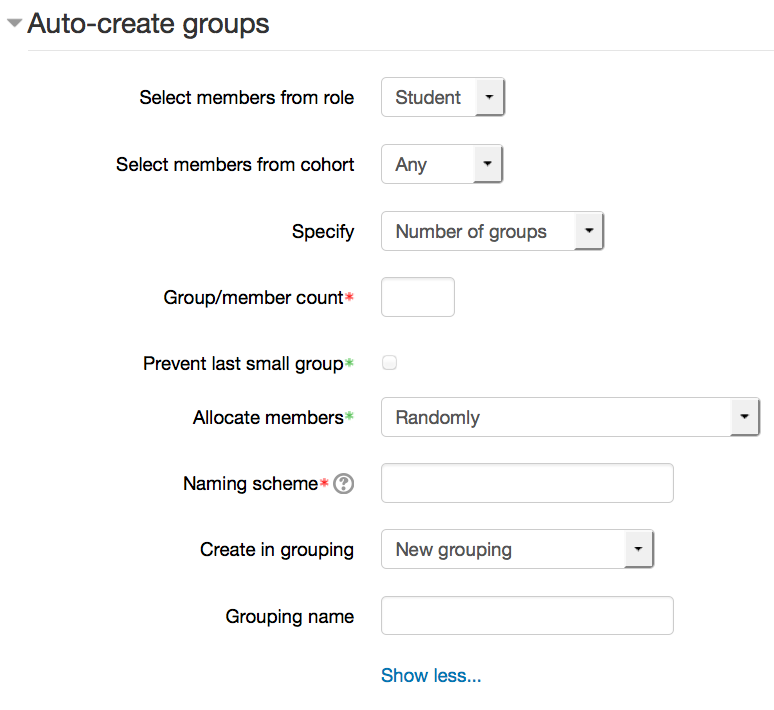
Auto-create groups settings

Select members from role - The members of your group will be selected from the pool of students by default. If you want to include teachers and students in the auto-creation, change this to "All".

Select members from cohort - Only site administrators should see this setting.

Specify - number of groups or members per group - do you want to break the class up into a specific number of groups, or by the number of people per group?

Group/member count - this field is required and is linked to the previous setting. i.e. If you want your students split into 3 groups, put 3 in here and have "number of groups" for the previous setting.

Prevent last small group - If there are not the right numbers to make even groups, often one group will be created that is smaller than the rest. Checking this will distribute those students amongst the existing groups instead, even if it pushes the numbers above the ones you specified for maximum members in a group.

Allocate members - your options are randomly, alphabetically by first name last name, alphabetically by last name first name, alphabetically by ID number.

Naming scheme - The at symbol (@) may be used to create groups with names containing letters. For example Group @ will generate groups named Group A, Group B, Group C, ...

The hash symbol (#) may be used to create groups with names containing numbers. For example Group # will generate groups named Group 1, Group 2, Group 3, ...
» Guide to Moodle

Contact site support
You are currently using guest access (Log in)
Data retention summary
Powered by Moodle